
Roof Bars vs. Roof Racks
Roof Rails, Bars, and Racks: What’s Best for Your Vehicle When Fitting a Roof Tent?
When you’re planning your next road trip or outdoor adventure, one of the first things to consider is how you’ll carry your gear. For many, a rooftop tent is the ultimate camping solution—convenient, elevated, and ready to go wherever the road takes you. But before you mount your tent and hit the road, it's important to understand what kind of roof mounting system your vehicle needs.
At Latitude Tents, we specialise in rooftop camping solutions, and that includes helping you choose the right roof bars, roof racks, or roof rails for a secure and safe roof tent installation.
What Are Roof Rails, Roof Bars, and Roof Racks?
Let’s break down the differences between these often-confused components to help you understand what’s best for your vehicle and your adventure.
🚙 Roof Rails
Roof rails usually come factory-installed on many SUVs, estate cars, and crossovers. They run front to back along the roof and offer sleek aesthetics and aerodynamic benefits.
While they can sometimes carry lightweight items, roof rails are mainly a base for mounting roof racks or crossbars. If your vehicle has raised or flush rails, you're already a step closer to being roof-tent-ready.
🔧 Roof Bars (Crossbars)
Roof bars—also known as crossbars—run side-to-side across your roof and are essential for attaching most roof tents. These bars are the direct support structure for the roof tent and must be chosen carefully to meet your tent’s weight requirements.
At Latitude Tents, we recommend checking your vehicle’s dynamic load limit (the weight it can carry while driving) and ensuring your roof bars meet that rating. If you’re unsure, please reach out.
🛠️ Roof Racks
A roof rack is often a complete system made up of crossbars, platforms, and sometimes modular accessories like cargo trays or holders. Roof racks are ideal for those who need more strength, versatility, and modularity—particularly useful if you’re carrying a heavier hard-shell roof tent, or additional gear like jerry cans, recovery tracks, or awnings. However, they are more often only available for larger SUVs, 4x4s and vans.
Roof Mounting Setups by Vehicle Type
Not every vehicle comes with the same roof mounting capabilities. Here’s a quick guide to the four most common roof setups and how they relate to roof tent fitting:
1. 🚗 Bare Roof Vehicles
If your vehicle doesn’t have factory rails or mounts, don’t worry—you can still fit a roof tent.
Solution: Use aftermarket roof bars with a door clamp system. We would only recommend Thule roof bars for this style of roof.
Best for: Sedans, hatchbacks, small cars.
Note: Check weight limits carefully. Not all bare-roof vehicles can handle larger tents.
2. 🧱 Rain Gutter Roof Systems
A feature on older 4x4s and vans, rain gutters allow for secure, clamp-on roof bar attachment.
Solution: Use gutter-mounted racks or bars.
Best for: Classic vans and cars pre-2000, older SUVs
Advantage: Very strong and ideal for heavy tents.
3. 🏭 Factory-Mounted Systems
Many modern vehicles have integrated mounting points—these may be visible or hidden under trim.
Solution: Custom-fit roof bars that click into the mounts.
Best for: SUVs, estates, crossovers and more.
Pro tip: These systems are often the most aesthetically pleasing.
4. 🔗 Raised Roof Rails
The most roof-tent-friendly option. Raised rails make fitting crossbars or full racks quick and easy.
Solution: Clamp-style bars or modular racks
Best for: Adventure-ready SUVs and 4WDs
Advantage: Easy to install and remove; widely compatible with Latitude Tents' range of roof tents.
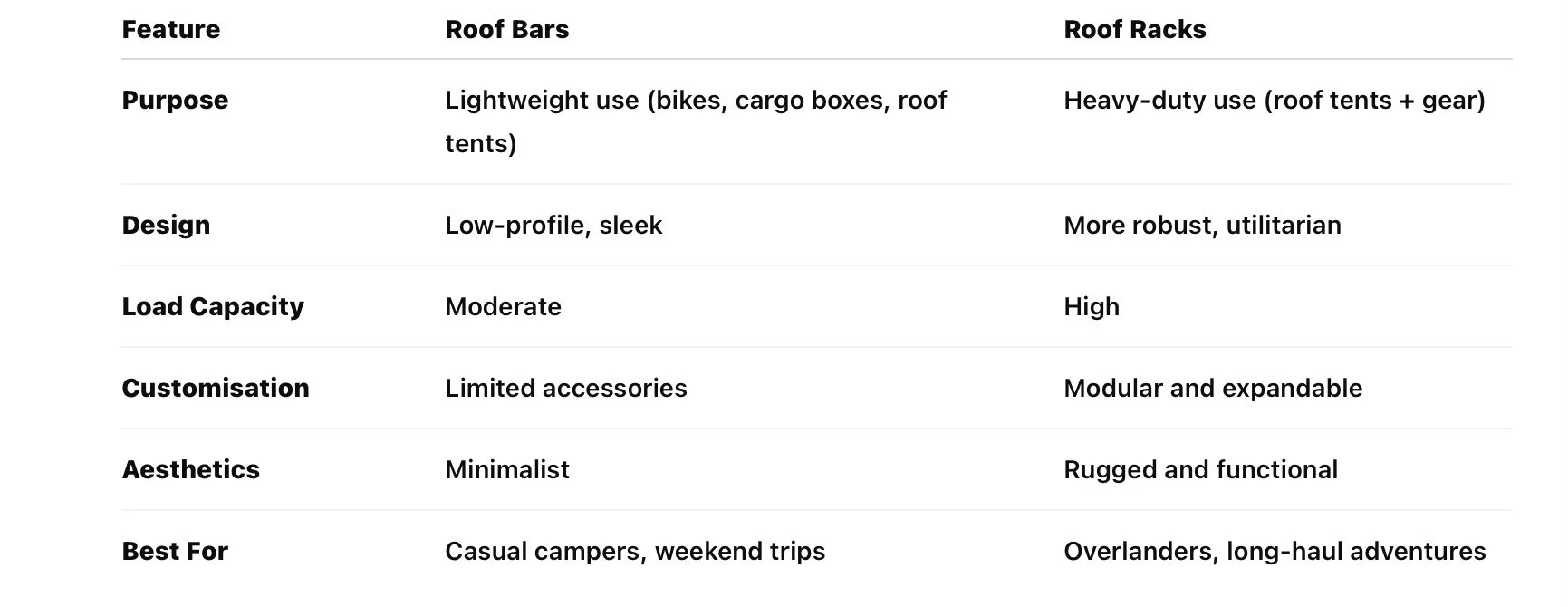
Roof Bars vs Roof Racks: What's the Difference?
If you're unsure whether to go for roof bars or a full rack system, here’s a quick comparison to help you decide:
Choosing the Right System for a Latitude Roof Tent
Not every roof tent is created equal, and not every vehicle can carry every tent. That’s why at Latitude Tents, we help customers match their tent to the right mounting system based on:
Vehicle type
Number of people to sleep
Tent weight
Trip duration
Desired accessories
At Latitude Tents, we’re not just about tents—we’re about creating complete, dependable, adventure-ready solutions. If you’re unsure about what your vehicle needs, reach out to our team for expert, no-obligation advice. We also offer a free fitting service!
